The bias is shared. The risk it protects is not.

Buyers and sellers are often described as though they arrive at a sales conversation with completely different psychological equipment. The buyer is supposedly cautious, the seller optimistic. The buyer protects the money, while the seller pursues the opportunity.
The reality is more interesting. Buyers and sellers often bring the same biases into the sale. They simply point those biases toward different risks.
The buyer is trying to avoid making a bad decision. The seller is trying to avoid losing a good opportunity. Both are being reasonable. Both are also interpreting the conversation through mental shortcuts that can quietly change what they see, hear and believe happened.
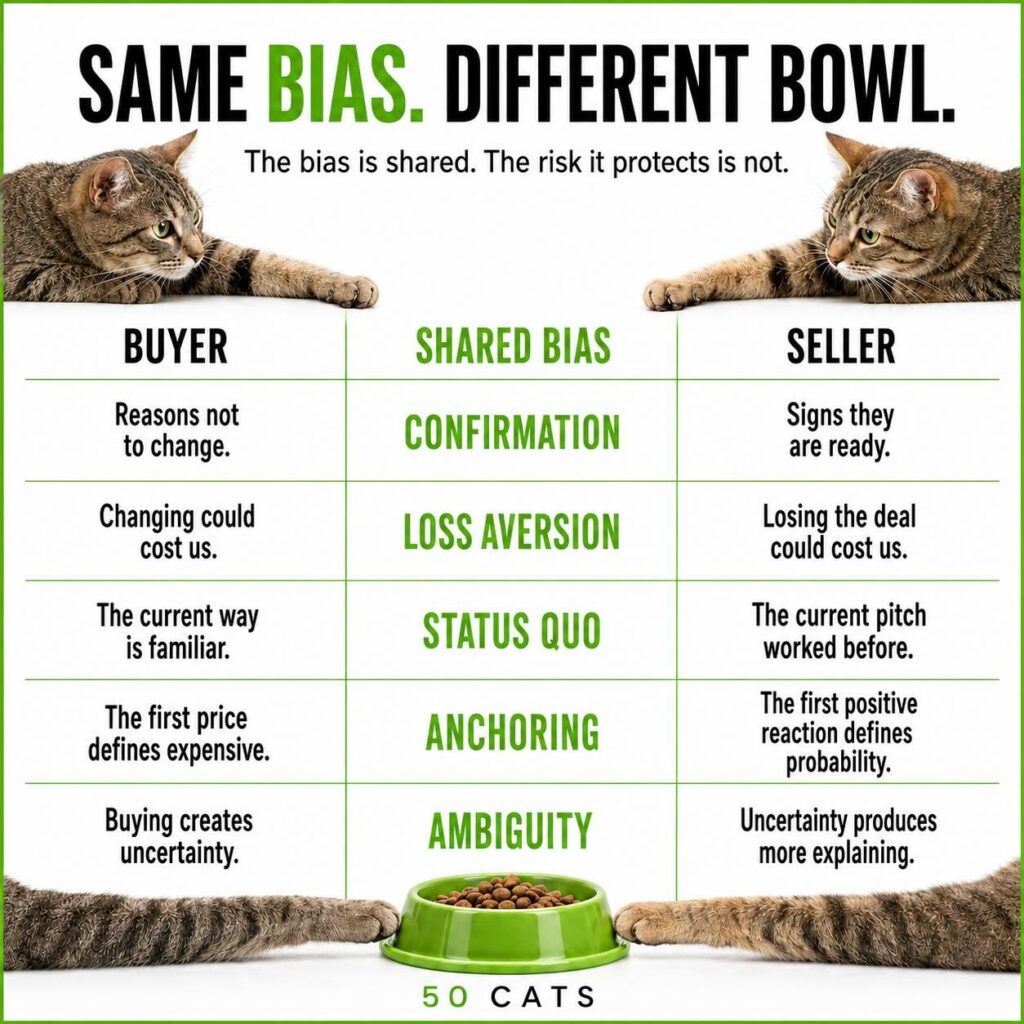
Same bias. Different bowl.
The chart below compares five biases that commonly appear on both sides of a sale. This is not every bias that can influence a decision, and the examples are not universal. They show how the same mental shortcut can produce different behavior depending on what someone believes they are protecting.
The buyer and seller are not psychological opposites. They are frequently two cats reaching for the same bowl while maintaining completely different explanations for why it belongs on their side of the table.

Confirmation bias
Confirmation bias makes people notice evidence that supports what they already believe and discount evidence that challenges it.
A buyer who believes changing will be difficult may focus on implementation time, unfamiliar features and possible disruption. Evidence that the new solution could reduce costs or eliminate a persistent problem receives less attention because it conflicts with the buyer’s existing conclusion.
A seller who believes the opportunity is progressing may interpret questions, compliments and continued meetings as buying signals. The missing budget, unclear authority or absence of a real timeline becomes a secondary detail because it does not support the more appealing story.
The collision happens when the buyer sees more reasons to remain cautious while the seller sees more reasons to become confident. Both sides leave the meeting with additional evidence, but they have not necessarily collected evidence about the same conclusion.
Two cats examined the same empty bowl. One saw proof that dinner was coming. The other began preparing a formal complaint.
Loss aversion
Loss aversion describes our tendency to feel a potential loss more strongly than an equivalent or even larger potential gain.
For the buyer, purchasing introduces several ways to lose. The company could spend money on the wrong solution, disrupt an existing process, choose the wrong supplier or force the person making the recommendation to explain why the decision failed.
The potential improvement may be larger than those possible losses, but the losses feel more immediate. A possible future gain must compete with money, control and credibility the buyer already possesses.
The seller is also responding to potential loss. They may discount too early, add unnecessary features or keep pursuing a weak opportunity because letting it go feels like losing revenue. The seller may also avoid asking a direct question because an uncertain opportunity feels more valuable than a clear no.
Both sides are trying to protect something. The buyer protects the resources and stability they already have. The seller protects the possibility of a deal they do not yet have.
Nobody wants to release the fish already under one paw to chase a larger fish that may or may not exist. The buyer and seller simply disagree about which fish is real.


Status quo bias
Status quo bias gives the existing situation an advantage simply because it is already established.
The buyer’s current system may be slow, expensive or irritating. Replacing it still requires a decision, resources and responsibility. Keeping it requires none of those things today, even if the long-term cost of doing nothing is higher.
This is why sellers often misunderstand the real competitor. The competitor may not be another company. It may be the buyer continuing to tolerate the problem.
Sellers have their own version of status quo bias. They continue using the same pitch, presentation, qualification process or follow-up sequence because it worked before—or because changing it would require admitting that it no longer works. The buyer preserves a familiar operating process while the seller preserves a familiar selling process.
The couch may have better cushions, more room and a documented return on investment. The cardboard box has tenure.
Status quo bias is not always irrational. Familiar systems sometimes remain in place because they are reliable, switching costs are real or the proposed improvement is too small. The mistake is assuming the current way must be best because it is current.
Anchoring
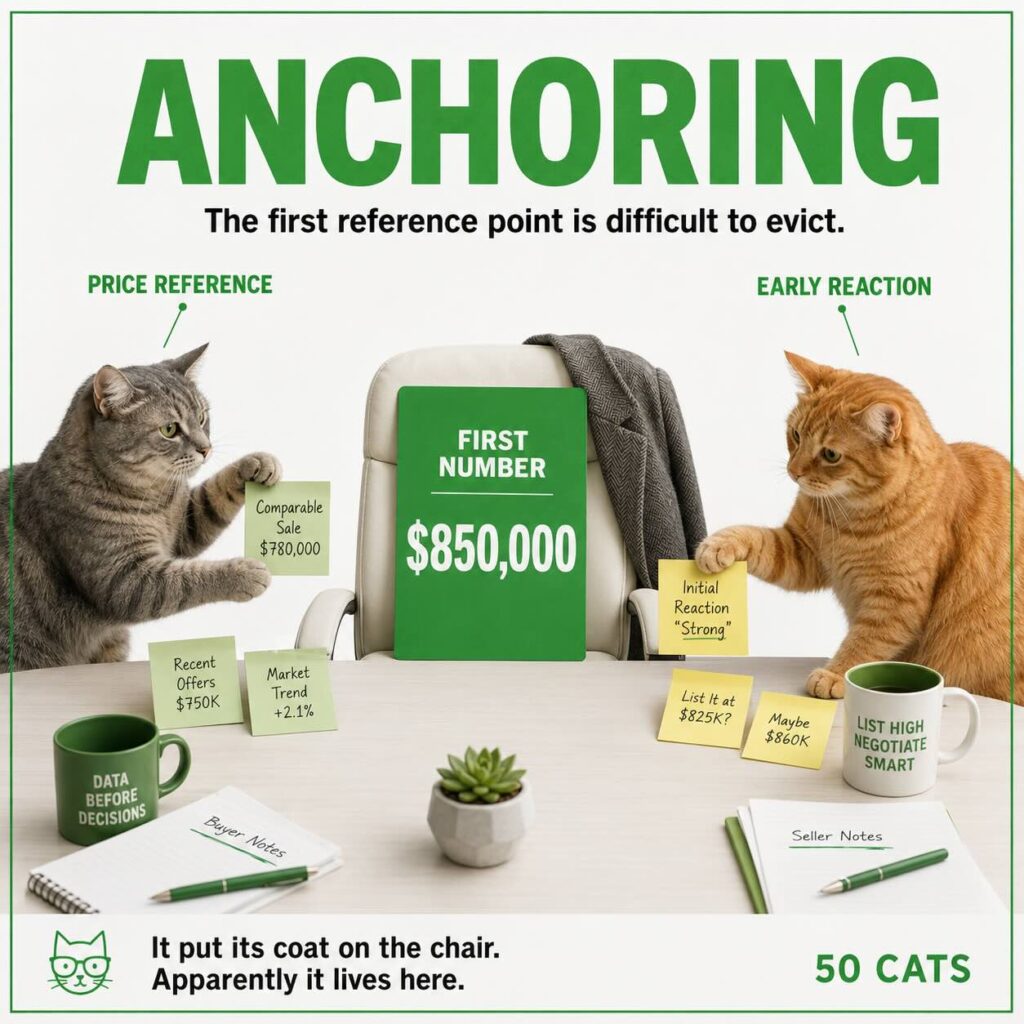
Anchoring occurs when the first meaningful number, idea or impression becomes the reference point for everything that follows.
For buyers, the most obvious anchor is price. An early number can define what feels expensive or reasonable even when it came from a different product, an outdated comparison or a solution that included completely different value.
Buyers can also anchor on timelines, promised results or a previous experience with a similar supplier. Once that reference point is established, new information is judged in relation to it rather than evaluated independently.
Sellers anchor too. A buyer’s first positive reaction can become the seller’s estimate of closing probability. An early revenue target can influence how much time the seller continues investing. A previous successful client can become the standard against which every new buyer is judged, even when the situations are not comparable.
The first number walks into the room, puts its coat on the chair and behaves as though it lives there.
Anchoring becomes especially dangerous when neither side realizes the original reference point was arbitrary. The negotiation then revolves around the anchor rather than the actual value, risk or situation.

Ambiguity aversion
Ambiguity aversion makes people prefer an option they understand over one with uncertain outcomes, even when the uncertain option may be better.
Buyers experience ambiguity around implementation, results, support, internal adoption and what happens after the contract is signed. A familiar problem can feel safer than a promising solution when the buyer cannot clearly picture the transition between the two.
Sellers experience ambiguity when they do not understand what the buyer is thinking. They may respond by presenting more features, sending more documents and answering questions the buyer has not asked. The seller believes additional information will create certainty, but the volume of information can make the decision feel even more complicated.
When the bowl is unclear, the seller brings the menu, the ingredients, the factory tour and a 37-slide history of bowls.
The buyer does not necessarily need more information. They may need a clearer understanding of what changes, what stays the same and what risk they are actually being asked to accept.
The biases collide during the conversation
These biases rarely operate one at a time. A buyer’s status quo bias can meet a seller’s optimism. The buyer’s loss aversion can cause hesitation, which the seller’s confirmation bias interprets as a request for more reassurance. The resulting presentation adds ambiguity, making the buyer even less comfortable with changing.
Nothing dramatic needs to happen. Both people can be intelligent, honest and genuinely interested in solving the problem. The conversation can still move in two different directions because each side is interpreting it through a different collection of risks.
This is how the seller leaves believing the opportunity moved forward while the buyer leaves believing they completed another useful piece of research.
Everyone believes they understood what happened. That is usually where the interesting part begins.

Bias is not the same as being wrong
Recognizing bias does not mean every concern should be challenged or overcome. A buyer may be right to avoid changing. The potential benefit may not justify the cost, disruption or uncertainty. A seller may also be right to feel optimistic because the buyer has demonstrated authority, urgency and intent.
Bias becomes a problem when an assumption quietly replaces evidence.
The useful question is not whether the buyer or seller is biased. Both are. The useful question is whether the conclusion is supported by what actually happened or by the story each side expected to find.
Understanding that difference is not about manipulating buyers into making decisions. It is about making the decision clearer for everyone involved.
Who started the conversation still matters
When the buyer initiates the sale, the seller may overestimate the buyer’s commitment because the interest arrived voluntarily. When the seller initiates it, the buyer may give the status quo an even larger advantage because the opportunity arrived as an interruption.
The biases remain shared, but the starting position changes how they appear.
For the emotional side of that experience—especially when you are selling something you personally created—read:
The honest bottom line
Buyers and sellers are not standing on opposite sides of logic. They are standing on opposite sides of risk.
The buyer wants to avoid a decision they may regret. The seller wants to avoid losing an opportunity that may have been real. Confirmation bias, loss aversion, status quo bias, anchoring and ambiguity aversion help both sides protect themselves, but they can also prevent either side from seeing the sale clearly.
The goal is not to remove every bias from the room. That would require replacing everyone involved, and the cats have reviewed the staffing budget.
The goal is to recognize which risk is actually shaping the conversation before both sides leave the same meeting carrying two completely different stories.