
Cold calling has a very simple promise.
Get more “no’s” and eventually you will get to the “yes.”
That sounds tough. It sounds disciplined. It sounds like something printed on a sales training slide with a mountain in the background.
And it is partially true.
But it is not fully grounded in reality.
Go a little deeper and you see the problem: people pushing cold calling tend to overvalue those no’s.
They count them like reps at the gym.
One no. Two no’s. Ten no’s. Keep going. Build character. Find the yes.
But every one of those no’s was a person.
A person you interrupted.
A person who may have been busy, annoyed, distracted, eating lunch, dealing with a customer, walking into a meeting, or just trying to have one normal Tuesday without a stranger pitching them something they did not ask for.
Maybe they do not hate you for life.
But they may remember the interruption.
They may attach that irritation to your business.
And they may talk.
That is the part the volume crowd skips over. Rejection is not free just because you decided to call it a numbers game.
What’s wrong?
The customer is not driving the lead process.
Cold calling starts with the seller’s need. We need leads. We need meetings. We need pipeline. We need activity. So let’s interrupt enough people until one of them has a pulse, a budget, and a temporary lapse in judgment.
A better lead system starts somewhere else.
It asks who is already showing signs they belong here.
Who has the right problem?
Who understands the value?
Who respects the process?
Who is likely to become a good customer instead of a tiny unpaid management job wearing pants?
Most businesses do need a lead system that brings in conversations. Some may need a system that brings in orders. But fully automating that process is dangerous.
Why?
Because you still want human eyes on it before the call.
A healthy lead generation system is not just a growth machine.
It is a filter.
The point is not “more leads at all costs.”
The point is getting the right people closer and keeping the wrong people from wandering into the house and peeing on the furniture.
Bad business often looks like revenue at first.
That is what makes it dangerous.
A bad lead can show up with a budget, urgency, and interest — and still be terrible business.
They have money.
They have a need.
They are ready to move.
And somehow, three weeks later, everyone in your company is whispering their name like it is a weather event.
The damage usually shows up after the sale.
Margin loss.
Endless revisions.
Weird expectations.
Slow payment.
Customer-service drag.
Staff frustration.
The owner muttering in the car like a detective in a cable drama.
That is not growth.
That is a raccoon in the ductwork.
And the worst part is that a lot of these leads tell on themselves early.
A lead says they need it by tomorrow, but they also want a discount.
They want your best work, but they do not want to follow your process.
They want certainty, but they cannot clearly explain what they want.
They want access to your thinking, but they are not sure they want to pay for it.
They want to “pick your brain,” “circle back,” “see what you can do,” and “keep this simple,” which somehow always means making it complicated for you.
These are not tiny quirks.
They are little warning flares wearing a name tag.
Discount obsession.
Disrespect for your process.
Fake urgency.
Vague decision-making.
“We’ll know it when we see it.”
Comparison shopping disguised as interest.
Renegotiating before anything has even started.
None of that means the person is evil.
It means they are probably not your customer.
That distinction matters.
A good lead system should not treat every inquiry like a golden ticket. Some inquiries are good. Some are neutral. Some are raccoons.
The job is to know the difference before they get inside.
This is where sales has to grow up a little.
Sales has a protective job, not just a persuasive job.
Sales is not there to convert every breathing organism with Wi-Fi.
Sales should protect the business.
Protect the margin.
Protect the team.
Protect the customer experience.
Protect the calendar.
Protect the owner’s sanity.
Protect the good customers from getting less attention because the bad customers are eating all the oxygen in the room.
That is the part people miss when they talk about lead generation like it is just a faucet.
Turn it on.
Get more.
Fill the bucket.
Wonderful.
But what if the bucket is full of garbage?
What if the system is producing conversations that were never going to be good business?
What if the sales process is rewarding the wrong kind of attention?
What if the company is so excited that someone raised their hand that nobody stops to ask whether that hand is holding a flamethrower?
A powerful lead system does not just create opportunity.
It creates judgment.
It gives the business permission to slow down before saying yes.
It gives the business a reason to ask better questions.
It gives the business a way to spot the difference between a good-fit customer and a future apology email.
And sometimes, it gives the business permission to say no early.
Not dramatically.
Not rudely.
Not with a speech.
Just cleanly.
Because saying no before the sale is cheaper than regretting yes after it.
Some leads get nurtured.
Some leads get sold.
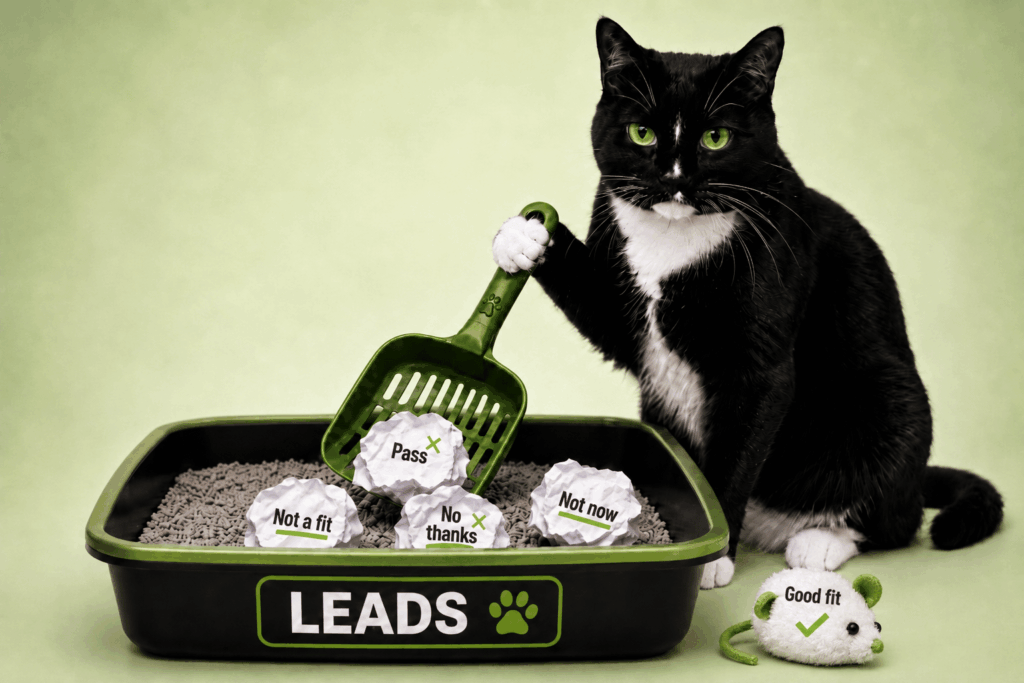
Some leads belong in the litter box.