
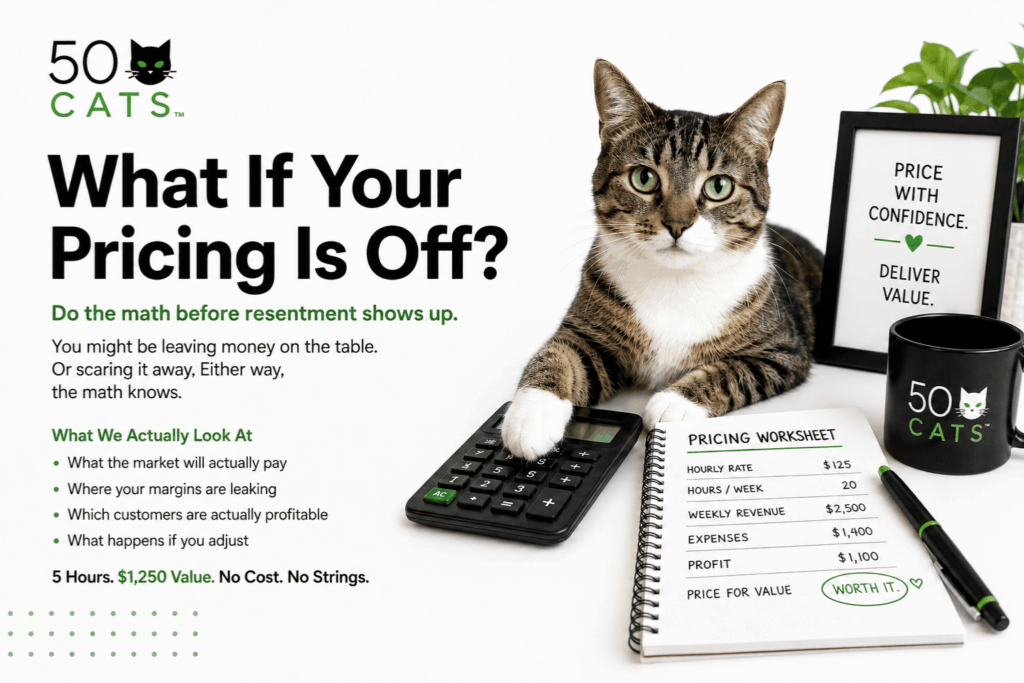
You might be leaving money on the table. Or scaring it away. Either way, the math knows
Pricing Is Where Most Businesses Quietly Bleed
Here’s the thing about pricing: when it’s wrong, it doesn’t announce itself. There’s no alarm. No flashing light. Your revenue just… underperforms. And you assume it’s a marketing problem, or a leads problem, or a “we need to work harder” problem. Meanwhile, the actual problem is sitting right there on your invoices, being polite about it.
You’re either charging too much and watching deals stall, or charging too little and working twice as hard for half the reward. Most people don’t know which one they are. Some are doing both at the same time, which is genuinely impressive in the worst possible way.
And this isn’t a small-business-only problem. Some of the biggest organizations on the planet have botched their pricing so badly it made international news in the last six months. The difference is they had billions in the bank to survive it. You probably don’t. So let’s look at what happens when pricing goes sideways — and what it means for the rest of us.
GitHub tried to charge developers for using their own computers.
In December 2025, GitHub announced a $0.002-per-minute fee for “self-hosted runners” — meaning if you ran code on your own hardware, in your own data center, on infrastructure you already paid for, GitHub wanted a cut. One developer calculated his bill would jump to $140 a month for the privilege of using his own stuff. The community response was so loud that GitHub reversed course within 24 hours. Their official statement said they “missed the mark.” That’s corporate for “we didn’t do the math on how angry people would be.”
The lesson: The price wasn’t crazy. The framing was. When your customers feel like you’re charging them for something they already own, it doesn’t matter how small the number is.
FIFA priced actual soccer fans out of the World Cup.
Ticket prices for the 2026 World Cup are running four to five times higher than Qatar in 2022. The cheapest group-stage seats start at $120–$265, and that’s for games that don’t even involve the host countries. Category 1 final tickets? $10,990. There’s a “Pitchside Lounge” package for $42,428 that doesn’t include parking. FIFA did slash some prices after global backlash, offering $60 seats to the most loyal supporters. Fan organizations called it “an appeasement tactic.”
The lesson: The pricing might hit FIFA’s revenue targets. It’s catastrophically wrong for the people who actually love the product. If you optimize for extraction instead of relationship, you’ll get the money — and lose the goodwill.
Healthcare SaaS companies raised prices into a buzzsaw.
In 2025, healthcare software providers pushed through price increases that triggered a 67% spike in revenue churn. EdTech wasn’t far behind — customer churn doubled from 11% to 22% in a single year. Across the top 500 SaaS companies, there were over 1,800 pricing changes in 2025 alone. The ones that didn’t protect legacy customers saw 10–15% churn spikes almost immediately.
The lesson: The price increases weren’t necessarily wrong. The rollout was. Fifty-eight percent of customers said they were fine paying more — once they understood why. The other 42% left, downgraded, or demanded discounts. The difference between those two groups was communication.
Grocery brands thought nobody would notice they shrank the bag.
In 2025, the U.S. Government Accountability Office published its most comprehensive study of shrinkflation ever. The findings: some national brands quietly reduced product sizes by over 30% without touching the price. Coffee drinkers are paying 32% more per unit than in 2019. Paper towel buyers, 12% more. Seventy-five percent of Americans noticed, and 81% of them changed their buying behavior. Sixty-four percent of global consumers now call it “unfair” — which is the polite version of what they’re saying at the checkout line.
The lesson: You can’t hide a pricing change inside the packaging. People do the math. And when they feel tricked, they don’t write you a letter about it — they just leave.
Every one of these stories has the same punchline: the price wasn’t the problem. The thinking behind the price was the problem. And if it can happen to GitHub, FIFA, and the entire healthcare SaaS industry, it can happen to you. The difference is those companies had PR teams and billion-dollar cushions. You have a business you built with your own hands and a mortgage that doesn’t care about your churn rate.
That’s why it’s worth spending five hours to find out where you actually stand.
What We Actually Look at in 5 Hours
This isn’t a pep talk. It’s not a webinar with a slide that says “know your worth.” We sit down with your actual numbers and figure out what’s going on. You leave with the math, not a motivational poster about hustle.
Your current pricing vs. what the market will actually pay. Not what your competitor charges. Not what some blog post says. What real buyers in your market are willing to spend, based on what you’re actually delivering.
Where your margins are leaking. The discounts you forgot about. The services you underprice because you’ve “always done it that way.” The scope creep you’ve been absorbing because saying no felt harder than doing free work.
Which customers are actually profitable. And which ones you’d secretly be relieved to lose. Every business has both. We just help you figure out which is which — with numbers, not feelings.
What happens if you adjust. Modeled before you touch a thing. So you can see what a price change would actually do to your revenue, your customer mix, and your Tuesday stress levels before you commit to anything.
5 Hours. $1,250 Value. No Cost. No Strings.
We’re giving away 5 hours of real sales consulting. Not a “free consultation” where someone reads you a script and tries to upsell you into a retainer. Five actual hours of looking at your pricing, your numbers, and your business — and telling you what we find.
Why? Because we just launched 50 Cats LLC and we’d rather show you what we can do than tell you about it. If the work speaks for itself, some of you will want to keep working together. If it doesn’t, you still walk away with $1,250 worth of pricing analysis for free. Either way, you win.
No contracts. No commitments. No “just checking in” emails for the next six months. We’re not going to stalk you. We’re going to help you.
Oh, and About the Cats
15% of all revenue from paying clients goes directly to food, vet care, and good homes for 50 cats. That’s not a marketing gimmick — it’s written into how we operate. So if you do end up becoming a client, your money doesn’t just buy better pricing strategy. It also buys kibble, vaccines, and the occasional shrimp for a cat named Mai who has very strong opinions about seafood.
We figure if your business is going to get smarter, some cats should get fed in the process. So even the math has a heart. And a tail. And an attitude problem at 3am.